
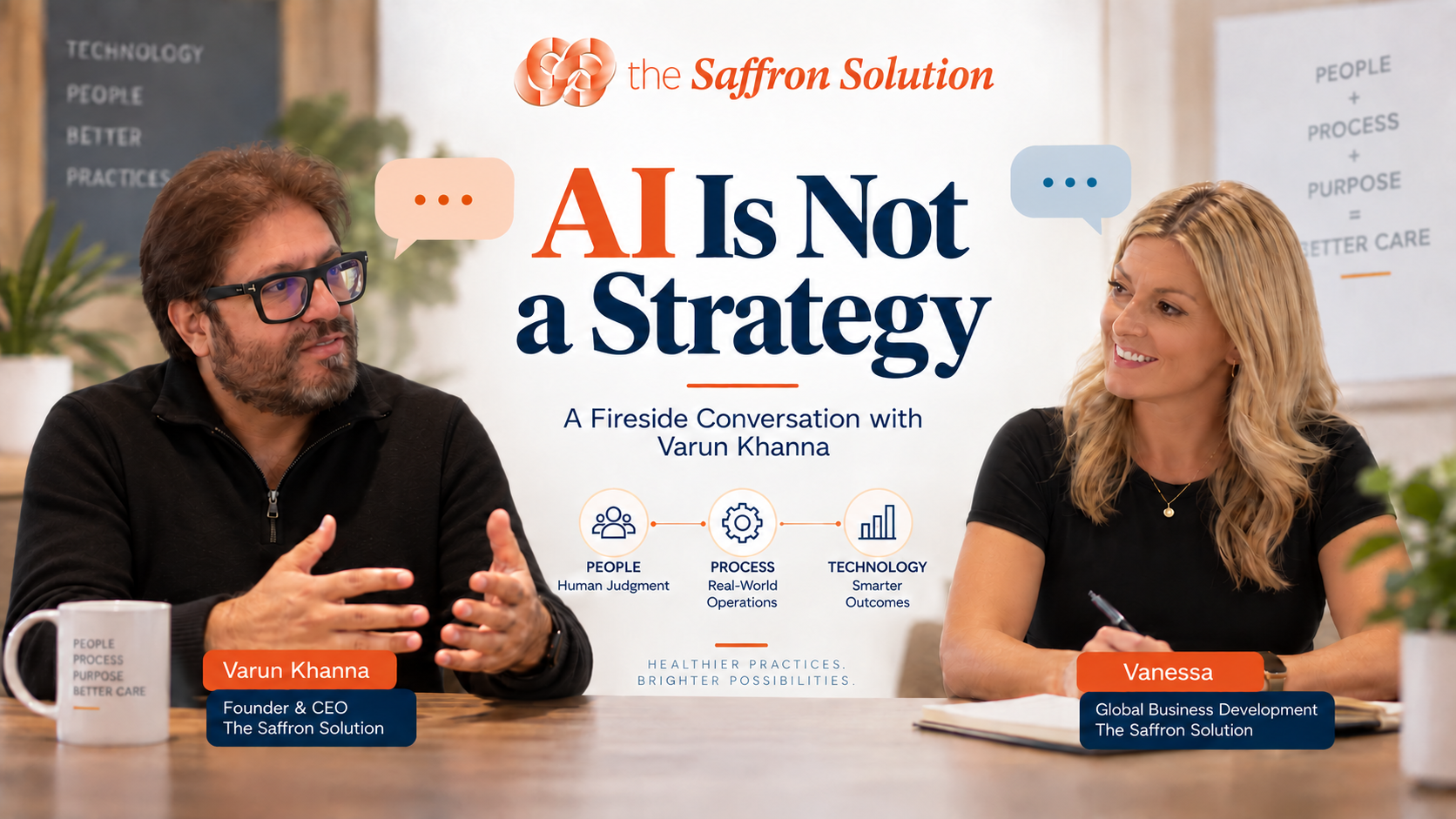
FIRESIDE CONVERSATION
AI Is Not a Strategy
A Fireside Conversation with Varun Khanna, Founder & CEO of The Saffron Solution
AI is changing healthcare quickly. This conversation focuses on the harder question: how should a medical practice decide where AI belongs, where it does not, and who remains accountable?
KEY DISCUSSION 01
THE AI PROMISE
From impressive demos to messy day-to-day operations.
VVANESSA
Varun, I feel like every physician we speak with is being sold AI right now.
AI calling. AI websites. AI SEO. AI scheduling. AI patient engagement. AI revenue cycle. AI agents.
Is AI really about to run the medical practice?
VKVARUN KHANNA
No.
And I say that as someone who is extraordinarily optimistic about AI.
AI is going to change healthcare. It is already changing healthcare. We use it. We build around it. We integrate it into workflows. There are things we can accomplish today that would have been prohibitively expensive or technically impossible just a few years ago.
But there is a very large distance between “AI can do this task” and “AI should be trusted to run this process inside a medical practice.”
That distinction seems to be getting lost.
Right now, physicians are being bombarded with demonstrations.
Someone shows you an AI agent making a phone call.
Someone shows you a website generated in 30 seconds.
Someone says AI can write your SEO content.
Someone says it can answer every patient call.
Someone says it can reactivate thousands of patients without anyone touching anything.
The demonstration is impressive.
But a medical practice does not operate inside a demonstration.
It operates in the real world.
VVANESSA
What does that mean?
VKVARUN KHANNA
It means Mrs. Jones has two phone numbers in the EHR.
It means her preferred language wasn’t entered correctly.
It means she saw a specialist six months ago, but the referral loop was never closed.
It means her insurance changed.
It means somebody documented something in the wrong field.
It means the physician doesn’t want a certain category of patients contacted until records have been reviewed.
It means the practice acquired another location and now there are duplicate patient records.
It means one physician wants the workflow handled one way and another physician wants it handled differently.
It means an appointment that looks like a cancellation isn’t really a cancellation because the patient was moved to another provider.
It means the EHR, practice-management system, phone platform, website, referral system and third-party applications don’t necessarily agree with one another.
That is medical practice operations.
AI doesn’t make those complexities disappear.
Sometimes it can help us understand them faster. Sometimes it can automate parts of them. Sometimes it can find patterns that humans would never realistically identify.
But someone still has to understand what the data means.
VVANESSA
So the problem isn’t AI?
VKVARUN KHANNA
Not at all.
The problem is treating AI like a magic box.
Buy the software.
Turn it on.
Problem solved.
That is precisely the thinking that created so much technology fragmentation in healthcare in the first place.
Practices bought a patient-engagement solution.
Then a texting solution.
Then a reputation-management solution.
Then a referral solution.
Then another analytics dashboard.
Then another scheduling application.
Then another bolt-on to the EHR.
Now we’re entering the AI era and somehow we’ve convinced ourselves that buying ten more AI applications is going to solve the problem created by buying ten disconnected applications.
It won’t.
You’ll simply have AI-powered fragmentation.
VVANESSA
That’s an interesting way of putting it.
VKVARUN KHANNA
Think about what happens when a physician sees an advertisement on Facebook.
“AI can reactivate all your lost patients.”
It looks incredible.
Then I get the phone call.
“Why aren’t we doing this?”
That’s a reasonable question.
But then we have to investigate.
What data does the company need?
Where does that data go?
What does it retain?
Who has access to it?
Does protected health information enter the system?
Will the vendor sign an appropriate Business Associate Agreement?
What subprocessors are involved?
Where are recordings stored?
How is identity established?
What happens when the person answering the telephone isn’t the patient?
What happens when the AI misunderstands something?
Who gets the exception?
Where does the interaction get documented?
Does it write back to the EHR?
What happens when the EHR contains bad data?
What happens when the patient asks a clinical question?
How is escalation handled?
Who monitors the system?
What’s the workflow when the automation fails?
And perhaps most importantly:
What problem are we actually trying to solve?
That’s a very different conversation from watching a two-minute AI demonstration.
KEY DISCUSSION 02
RISK & RESPONSIBILITY
HIPAA, governance and the human role around AI.
VVANESSA
And healthcare adds another layer because of HIPAA.
VKVARUN KHANNA
Absolutely.
Healthcare isn’t selling shoes.
Patient information carries legal, operational, ethical and human responsibilities.
HHS is quite clear that vendors creating, receiving, maintaining or transmitting protected health information on behalf of a covered healthcare entity can fall under HIPAA’s business-associate requirements. HHS even specifically identifies certain third-party AI chatbots used for patient services as an example. (HHS.gov)
And using cloud technology for electronic protected health information doesn’t make those obligations disappear. HHS states that appropriate Business Associate Agreements, safeguards and risk-management responsibilities still apply. (HHS.gov)
That’s why the question should never simply be:
“Does it have AI?”
The questions are:
What is the use case?
What information is involved?
What systems does it touch?
What can go wrong?
What controls exist?
Who is accountable?
And where does a human remain in the loop?
Those aren’t anti-technology questions.
Those are technology questions.
VVANESSA
But physicians hear constantly that AI is getting so sophisticated that humans won’t be necessary.
VKVARUN KHANNA
There is an enormous difference between reducing human labor and eliminating human responsibility.
Even the organizations developing the world’s most sophisticated AI systems spend enormous resources on evaluation, testing, monitoring, safety systems and human governance.
NIST’s AI Risk Management Framework exists because deploying AI is fundamentally a risk-management exercise as well as a technical one. Its generative-AI work specifically focuses on identifying, measuring and managing risks throughout deployment. (NIST)
And in healthcare, the AMA has been particularly clear. It uses the term “augmented intelligence” intentionally: technology should enhance human intelligence rather than simply replace it. Its current policies emphasize transparency, accountability, governance and physician oversight. (American Medical Association)
That isn’t a rejection of AI.
It is a mature understanding of AI.
VVANESSA
Do you think physicians understand enough about the technology they’re purchasing?
VKVARUN KHANNA
That’s probably the uncomfortable part of this conversation.
Physicians are extraordinarily educated people.
But their education is medicine.
A retina specialist may understand the eye at a level very few human beings ever will.
That doesn’t automatically make that physician an expert in LLM architecture, cybersecurity, API integrations, database structures, attribution models, search-engine architecture, telecommunications infrastructure, robotic process automation or healthcare data interoperability.
Nor should it.
Your daytime job is being a physician.
The mistake is believing that expertise in one highly complex field automatically translates into expertise in another highly complex field.
I don’t tell ophthalmologists how to perform cataract surgery.
Yet technology companies routinely put physicians in a position where they’re effectively being asked to architect their own technology stack based on advertisements, conference demonstrations, LinkedIn posts and conversations with colleagues.
That’s not a reasonable expectation.
KEY DISCUSSION 03
STRATEGY BEFORE SOFTWARE
Why the workflow and the problem come before the tool.
VVANESSA
Is physician education becoming part of Saffron’s job?
VKVARUN KHANNA
Increasingly, yes.
And perhaps that’s one of the things I didn’t anticipate when we built this company.
The Saffron Solution works with scores of medical practices across the United States. We have a team of approximately 100 people working across time zones. We interact with numerous EHRs, practice-management platforms, communication systems, websites, third-party applications and enormous volumes of operational data.
Every month, there are hundreds of thousands of individual tasks, transactions, signals and data points moving through the environments in which we work.
Building technology is hard.
Integrating technology is hard.
Understanding dirty healthcare data is hard.
Managing complex workflows is hard.
But increasingly, one of the most time-consuming things we do is explaining why we are not implementing the newest thing someone saw advertised yesterday.
Sometimes the answer is:
“That technology is excellent. We should look at it.”
Sometimes it’s:
“We already have a better way of accomplishing that.”
Sometimes it’s:
“It solves one problem but creates three others.”
Sometimes it’s:
“It isn’t appropriate for the data involved.”
Sometimes it’s:
“The technology is promising, but it’s not ready for this workflow.”
And sometimes it’s simply:
“You don’t need it.”
A good technology partner has to be willing to say all six.
VVANESSA
That last one probably isn’t great for selling software.
VKVARUN KHANNA
Exactly.
We’re not trying to sell software.
That’s the difference.
The Saffron Solution isn’t a virtual-assistant company.
We’re not a staffing company with some technology wrapped around it.
And we’re not a software company trying to find another subscription to sell a medical practice.
We’re a healthcare technology and operations company.
Our job is to understand how the practice actually functions and then determine where people, automation, data, integrations, AI and other technologies belong.
Sometimes the answer is AI.
Sometimes it’s RPA.
Sometimes it’s an API.
Sometimes it’s OCR.
Sometimes it’s a simple workflow change.
Sometimes it’s a human being making a phone call.
Sometimes it’s fixing the data before automating anything at all.
The objective isn’t to use the most fashionable technology.
The objective is to solve the problem.
VVANESSA
So what should a medical practice have before it starts buying AI tools?
VKVARUN KHANNA
A technology strategy.
And more practices need one.
Before buying anything, somebody should understand the entire environment:
What systems does the practice already own?
Where is its data?
What information can actually be trusted?
Where does work fall through the cracks?
Which processes are repetitive?
Which processes require judgment?
Which workflows involve PHI?
Which activities genuinely benefit from AI?
Which can be handled with conventional automation?
Where are humans indispensable?
What needs to integrate with the EHR?
Who owns the result?
How will success be measured?
What happens when something goes wrong?
That’s strategy.
Buying an AI agent isn’t strategy.
VVANESSA
There’s almost an irony here. AI is supposed to simplify everything, yet you’re saying organizations need more thought before deploying it.
VKVARUN KHANNA
Absolutely.
The easier technology becomes to purchase, the more discipline organizations need in deciding what not to purchase.
That’s going to become one of the defining management challenges of the next few years.
We’re entering a world where practically every department can buy an AI tool with a credit card.
That’s powerful.
It’s also dangerous organizationally.
You can very quickly end up with patient data scattered across vendors, duplicative systems, inconsistent workflows, unknown subprocessors, uncontrolled integrations and nobody quite sure which system is the source of truth.
Healthcare doesn’t need another generation of silos.
KEY DISCUSSION 04
WHERE AI BELONGS
Practical value, accountability and the operating model.
VVANESSA
Where do you think AI genuinely belongs in medical practice operations?
VKVARUN KHANNA
Everywhere that it creates measurable utility with appropriate controls.
That’s deliberately a broad answer.
AI can be tremendously useful for identifying patterns in operational data, assisting with communication, analyzing large datasets, supporting administrative workflows, summarizing information, extracting structured information from unstructured documents, helping prioritize work, improving search and enabling entirely new interfaces between humans and technology.
The opportunity is enormous.
And physicians themselves clearly recognize that. The AMA reported in 2026 that more than 80% of surveyed physicians were using AI professionally in some form. At the same time, physicians continued to identify privacy and the integrity of the physician-patient relationship among their major concerns. (American Medical Association)
Those two things can be true simultaneously.
AI can be extraordinary.
And AI can require extraordinary care.
Maturity means being able to hold both thoughts at once.
VVANESSA
So when a physician asks you, “Should my practice be using AI?” what do you say?
VKVARUN KHANNA
I say you’re asking the wrong question.
Your practice probably already is using AI somewhere, whether you realize it or not.
The better question is:
“Where should AI be used in my practice, where shouldn’t it be used, and who is responsible for making that determination?”
That’s a far more important conversation.
VVANESSA
And where does The Saffron Solution fit into that?
VKVARUN KHANNA
Between the promise and the reality.
Our clients don’t need us to be excited about every new technology.
They need us to understand it.
They don’t need another vendor pushing another product.
They need someone looking across the practice.
Across the EHR.
Across the practice-management system.
Across patient communications.
Across referrals.
Across surgery management.
Across reactivation.
Across data.
Across marketing.
Across websites and search.
Across transportation.
Across staffing.
Across automation.
Across AI.
And asking one very simple question:
Does this make the practice work better?
If it does, let’s understand it, secure it, integrate it, measure it and use it.
If it doesn’t, we should have the discipline to leave it alone.
VVANESSA
Last question. Are physicians getting in their own way when it comes to AI?
VKVARUN KHANNA
Sometimes.
But I don’t mean that as criticism.
Physicians are trying to navigate an extraordinarily noisy marketplace while simultaneously taking care of patients and running businesses.
Every day someone tells them they’re falling behind.
“You need AI.”
“You need this platform.”
“You need this new agent.”
“Your competitors are already doing it.”
Fear is becoming a sales strategy.
I think we need to turn the volume down.
You do not need to chase every technological development.
You need people around you whose job is to understand those developments, challenge them, test them and decide whether they belong inside your practice.
That is very different.
The physician should remain curious.
Ask questions.
Challenge us.
Send us the advertisement you saw.
Send us the technology your colleague mentioned.
We will look at it.
But allow expertise to work both ways.
You spent decades learning medicine.
We spend every day in the machinery underneath medical practice operations.
That partnership works extraordinarily well when both sides respect what the other knows.
And perhaps that is my biggest thought about AI right now.
The future of healthcare isn’t humans versus AI.
It isn’t even humans replaced by AI.
I think the interesting future is what happens when good physicians, good operators, good data, thoughtful technology and properly governed AI are finally brought together.
That’s considerably harder than buying another piece of software.
But it is also considerably more useful.
END OF CONVERSATION
Technology should solve work, not create another silo.
The practical takeaway
Start with the problem, not the tool. Understand the workflow, the data, the risks, the integrations and the people responsible for the outcome. Then decide whether AI, conventional automation, an integration, a workflow change—or a human being—is the right answer.
— Varun Khanna
Founder & CEO
The Saffron Solution
“The future of healthcare isn’t humans versus AI.”