
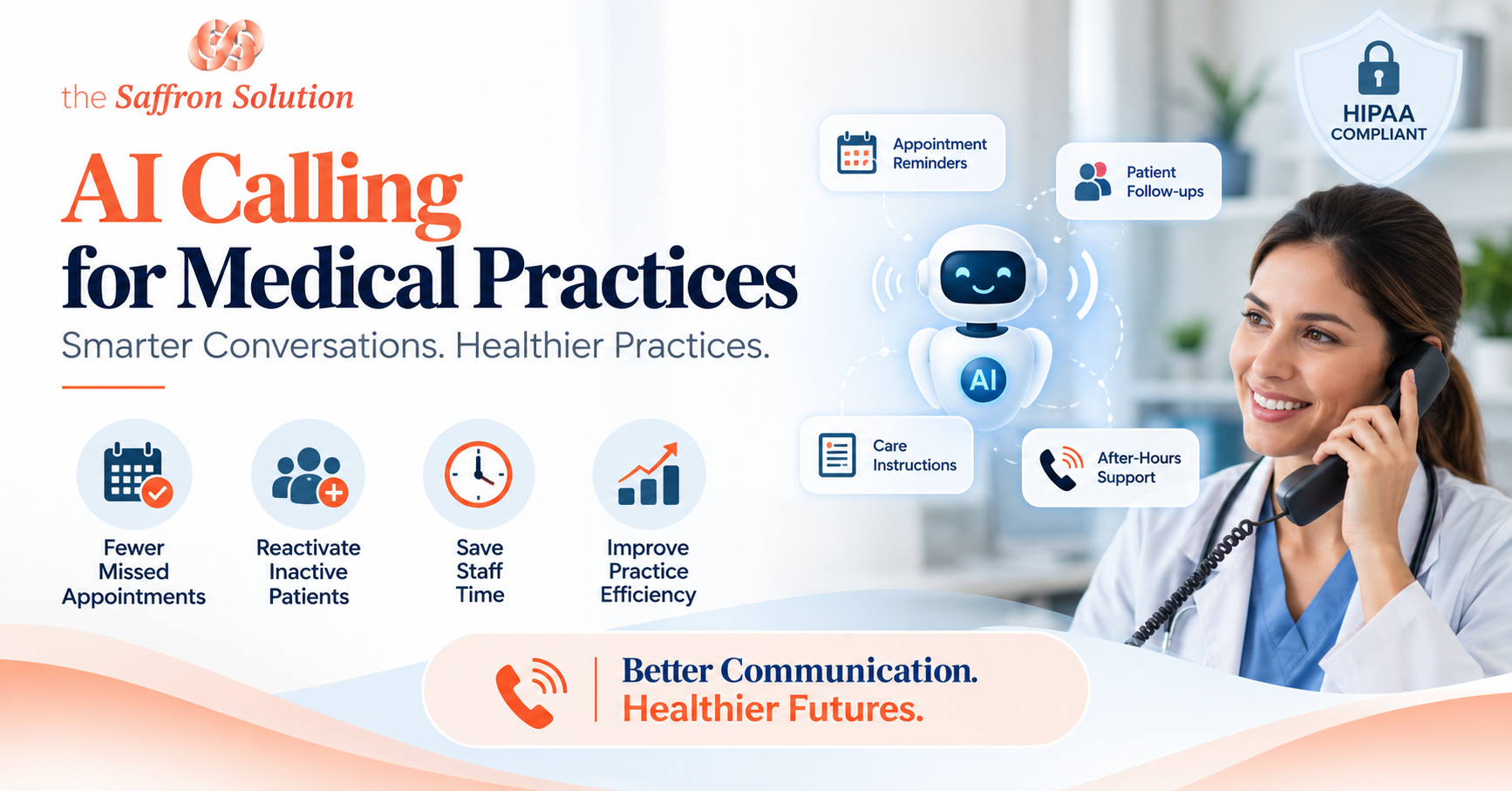
AI Calling in Medical Practices: Why “Just Any AI Caller” Can Create a Serious HIPAA and Legal Risk
Artificial intelligence can now call a patient, carry on a natural conversation, answer routine questions, confirm an appointment, identify a cancellation, help reschedule a visit and potentially reactivate a patient who has fallen out of care.
For a medical practice, the opportunity is significant.
So is the risk.
A healthcare organization cannot evaluate an AI calling platform simply by asking:
“Does the voice sound natural?”
The more important questions are:
Where does the patient’s information go? Who can access it? What does the AI disclose before verifying who answered? Is the vendor permitted to handle protected health information? Has the practice obtained the appropriate telephone consent? What happens to recordings and transcripts? Are those conversations used to train AI models? What happens if someone other than the patient answers?
And perhaps the most basic question:
Will the AI company sign an appropriate HIPAA Business Associate Agreement?
If an AI vendor creates, receives, maintains or transmits protected health information on behalf of a HIPAA-covered medical practice, that vendor may be a Business Associate under HIPAA.
HHS’s current Business Associate guidance specifically gives the example of a third-party AI chatbot used by a provider for services involving patient PHI, including medical reminders and appointment scheduling, as a Business Associate.
That distinction changes the conversation entirely.
AI Calling for Healthcare Is Not the Same as Ordinary AI Calling
An ordinary business may use an AI voice agent to call a customer about a reservation, product or service.
A medical practice operates in a fundamentally different information environment.
An AI conversation could involve:
- a patient’s name;
- telephone number;
- date of birth;
- appointment date or time;
- physician or specialist;
- procedure;
- diagnosis;
- medication;
- insurance information;
- previous treatment;
- reason for follow-up;
- missed appointment;
- recommended follow-up interval;
- surgical status;
- laboratory information;
- referral information; or
- other individually identifiable health information.
Once protected health information is involved, the technology must be evaluated in the context of the HIPAA Privacy Rule, HIPAA Security Rule and HIPAA Breach Notification Rule, not merely as a convenient telephone application.
The HIPAA Security Rule requires regulated entities to implement appropriate administrative, physical and technical safeguards for electronic PHI. It also requires an accurate and thorough assessment of potential risks and vulnerabilities to ePHI.
This means connecting an EHR to a consumer AI voice platform without first evaluating its HIPAA role, security architecture, contracts, data handling and downstream vendors can create substantial compliance exposure.
The First Question: Will the AI Calling Vendor Sign a BAA?
For many medical practices evaluating AI calling, this should be a threshold question.
A Business Associate Agreement (BAA) is not simply a marketing badge saying that a technology company is “HIPAA ready.”
It is a contractual framework governing how a Business Associate may use and disclose PHI and requiring appropriate safeguards.
HHS explains that Business Associates generally include organizations performing functions or providing services on behalf of a covered entity that involve creating, receiving, maintaining or transmitting PHI. Subcontractors performing those activities on behalf of Business Associates can also fall within the Business Associate framework.
The same underlying principle matters when evaluating the cloud infrastructure supporting an AI voice system.
A practice should therefore understand not merely the AI calling company’s contract, but the entire PHI data chain.
EHR → Integration Layer → AI Orchestration Platform → Language Model → Voice Platform → Telecommunications Provider → Transcription/Storage → Analytics → EHR
Which organizations in that chain receive, maintain or transmit PHI?
Which are Business Associates or subcontractors?
Where required, are appropriate BAAs in place?
A medical practice should know the answers before PHI begins flowing through the system.

“HIPAA Compliant” Is Not a Feature Checkbox
A common mistake is treating HIPAA compliance as though it were a software feature.
It is not.
A vendor stating on its website that it supports encryption or that its infrastructure is “HIPAA compliant” does not, by itself, make a medical practice’s deployment compliant.
Compliance depends on the relationship, configuration, safeguards, contracts, permissible uses of information and how the technology actually operates.
Medical practices should therefore be cautious about statements such as:
“Our servers are HIPAA compliant.”
That does not answer whether the entire AI calling workflow is appropriately designed to handle PHI.
What Could Go Wrong With a Regular AI Calling Platform?
Consider a patient who previously saw an ophthalmologist.
An AI agent calls:
“Hello, may I speak with Jane Smith?”
Someone says yes.
The AI continues:
“Jane, you missed your glaucoma follow-up with Dr. Smith last month and you’re overdue for your pressure check. Would you like me to schedule you?”
The person who answered is actually Jane’s roommate.
The AI has now potentially disclosed information connecting Jane with a physician, a medical condition and overdue treatment.
The AI performed exactly as programmed.
The workflow may still have created an impermissible disclosure.
That illustrates why conversational ability and privacy controls are two very different things.
Authentication Must Come Before Sensitive Disclosure
One of the most important design principles for healthcare AI calling should be:
Identify First. Disclose Second.
HIPAA requires regulated entities in applicable circumstances to verify the identity and authority of people requesting access to PHI when they are not already known.
Importantly, HIPAA does not prescribe one universal technical authentication method for every AI call.
Therefore, saying that HIPAA universally “requires date-of-birth verification on every AI call” would be inaccurate.
But from a risk-management perspective, an AI voice workflow capable of discussing sensitive patient information should incorporate an appropriately designed authentication process.
A Risk-Based AI Patient Verification Model
Depending upon the information being discussed, practices could implement progressively stronger authentication.
Level 1 — Minimal-Information Call
Before authentication:
“Hello, this is an automated assistant calling from ABC Medical Practice. May I speak with Jane Smith?”
No diagnosis. No procedure. No detailed appointment information. No clinical reason for the call.
Level 2 — Patient Verification
Before moving into PHI, the system could request one or more previously established identifiers, such as:
- month and day of birth;
- full date of birth where appropriate;
- ZIP code;
- a pre-established PIN;
- a one-time passcode sent to the patient’s verified mobile device;
- another identifier already contained in the patient record.
The exact method should be based on the sensitivity of the information and the practice’s risk assessment.
Level 3 — Sensitive Information
More sensitive conversations should require stronger authentication.
An AI caller should not casually reveal diagnoses, medications, test results, procedures or other sensitive clinical information simply because someone answered the patient’s telephone.
For higher-risk interactions, multi-factor verification or transition to an authenticated patient portal or human team member may be preferable.

Date of Birth Should Not Automatically Be Treated as a Secret Password
Date of birth can be useful as one verification factor.
But it is frequently discoverable.
Birthdays appear on social networks, public records, data-broker databases and other sources.
Consequently, practices should think in terms of authentication strength rather than simply asking one question.
For lower-risk interactions, confirming a limited piece of demographic information may be reasonable.
For a conversation involving sensitive clinical PHI, combining factors can provide a stronger safeguard.
Something the patient knows: partial DOB or PIN.
Something the patient possesses: verified phone receiving a one-time code.
Something already known to the practice: another demographic attribute contained in the patient record.
The goal is not to make every appointment reminder feel like logging into a bank.
The goal is to make the privacy control proportionate to the information the AI may disclose.
What If Someone Else Answers?
This scenario must be designed before deployment.
The AI should have rules governing responses such as:
- “She’s not here.”
- “I’m her husband.”
- “I’m her daughter.”
- “I handle all his medical appointments.”
- “What is this regarding?”
- “Tell me why you’re calling.”
- “He has dementia. You can talk to me.”
- “She passed away.”
The system should not improvise access rights.
Instead, it should follow the practice’s policies and the patient’s documented permissions, personal representative information and communication preferences.
Where identity or authority cannot be appropriately established, the AI should disclose as little information as possible and route the situation to a human when necessary.
HIPAA's Minimum Necessary Principle Still Matters
HIPAA’s minimum necessary standard generally requires regulated entities to take reasonable steps to limit applicable uses, disclosures and requests for PHI to what is necessary to accomplish the intended purpose.
There are important exceptions—including certain disclosures for treatment and disclosures to the individual—so the standard should not be overstated as applying identically to every patient interaction.
Nevertheless, the underlying privacy-engineering principle is highly relevant when determining how much information an AI platform should be allowed to access.
If the task is:
Confirm tomorrow’s appointment
the AI may need only the information required to perform that function.
If the task is:
Reactivate patients overdue for follow-up
the system may need additional structured information.
Access should follow the purpose.
Give the AI what it needs to perform the authorized workflow—not everything available in the EHR.
Appointment Reminders Are Permitted Under HIPAA—but That Does Not Make Every Technology Deployment Compliant
There is an important distinction here.
HHS states that appointment reminders are considered part of treatment and therefore may be made without obtaining a separate HIPAA authorization.
That does not mean:
“Any AI company can receive the patient list and start calling.”
The disclosure of PHI to the technology provider must itself be permissible.
The appropriate Business Associate relationship may need to exist.
The Security Rule still applies.
Appropriate safeguards still apply.
Telephone and communications laws still apply.
Patient communication preferences still matter.
And the content disclosed during the call still matters.
AI-Generated Voice Calls Are Regulated Under the TCPA
HIPAA is only one part of the compliance picture.
In February 2024, the Federal Communications Commission confirmed that AI-generated voices fall within the meaning of “artificial or prerecorded voice” under the Telephone Consumer Protection Act (TCPA).
The FCC’s Declaratory Ruling states that callers using such technologies must obtain prior express consent unless an emergency purpose or exemption applies. The FCC also states that artificial or prerecorded voice messages are subject to identification/disclosure requirements, and telemarketing or advertising calls carry specified opt-out requirements.
This is extremely important for medical practices.
HIPAA permission does not automatically equal TCPA permission.
A communication may be permissible under HIPAA but still have separate requirements under telecommunications law.

Healthcare Has Some TCPA Exceptions—but Practices Should Not Overread Them
The FCC has established a limited healthcare-related exemption for certain calls subject to HIPAA.
The FCC identified categories including:
- appointment and exam confirmations and reminders;
- wellness checkups;
- hospital preregistration instructions;
- preoperative instructions;
- certain lab-result communications;
- post-discharge follow-up intended to prevent readmission;
- prescription notifications; and
- home-health instructions.
But the exemption contains conditions and does not provide a blanket exemption for every healthcare call.
The FCC specifically excluded calls containing telemarketing, solicitation or advertising content, as well as certain financial communications, from that healthcare exemption.
That becomes particularly important with patient reactivation.
A call saying:
“You are overdue for a medically recommended follow-up”
may raise a different legal analysis than:
“We haven’t seen you lately. Schedule this month and receive 20% off a cosmetic service.”
The technology may be identical.
The legal purpose and content of the communication are not.
Practices should have counsel evaluate TCPA consent requirements for each calling use case rather than assuming “healthcare” automatically creates an exemption.
Consent Must Be Designed Into the Workflow
Medical practices should maintain a defensible consent and communication-preference framework.
Depending on the communication and applicable laws, the patient record should be capable of documenting items such as:
- telephone number supplied by the patient;
- permission to call that number;
- consent required for artificial/prerecorded calls where applicable;
- SMS preferences;
- voicemail preferences;
- preferred communication channel;
- language preference;
- restrictions requested by the patient;
- revocation or opt-out;
- date consent was obtained;
- method through which consent was obtained; and
- version of the consent language presented.
Consent should not live in an isolated spreadsheet.
It should be actionable data.
When a patient revokes applicable permission, automated workflows should know it.
AI Voice Disclosure Should Be Considered Separately From HIPAA
Because the FCC treats AI-generated voice technology as artificial/prerecorded voice for TCPA purposes, practices must also evaluate applicable call-identification and disclosure obligations.
From a patient-trust perspective, we believe medical practices should go further than trying to make an AI agent secretly indistinguishable from a human.
A patient interaction could begin transparently:
“Hello. I’m the automated virtual assistant calling on behalf of ABC Medical Practice.”
Transparency is not a weakness.
In healthcare, it can be part of trust.
After-Hours and Weekend AI Calls Require the Same Protections
AI can be particularly useful after hours.
A practice closes at 5:00 PM.
Patients do not.
An appropriately designed AI system could potentially help with:
- appointment requests;
- cancellations;
- rescheduling;
- routine frequently asked questions;
- directions;
- office hours;
- non-clinical instructions;
- collecting information for staff follow-up.
But an after-hours system should have hard boundaries.
It should know when not to continue.
Possible emergency → emergency instructions / escalation
Clinical advice request → appropriate clinical escalation
Unable to authenticate → stop PHI disclosure
Uncertain patient identity → human follow-up
Patient becomes distressed → escalation
Question outside approved knowledge → do not invent an answer
A generative AI system should never be allowed to hallucinate its way through a clinical conversation.
What Happens to the Recording and Transcript?
This is one of the most overlooked questions in AI voice deployment.
Modern AI calling may create:
- telephone audio;
- speech-to-text transcription;
- AI prompts;
- model responses;
- conversation summaries;
- call metadata;
- analytics; and
- structured information written back into the EHR.
Each layer needs to be evaluated.
A practice should ask its vendor:
Are calls recorded?
Where are recordings stored?
Are transcripts retained?
For how long?
Who can access them?
Are they encrypted in transit and at rest?
Are recordings or transcripts used to train any model?
Can subcontractors access PHI?
What happens when the contract ends?
Can the practice obtain or delete its data as permitted by law and contract?
What security-incident and breach-notification obligations exist?
A generic statement that “we use enterprise-grade encryption” does not answer these questions.
Never Assume “We Don’t Train on Your Data” Means HIPAA Compliance
An AI company may promise not to train its models on customer conversations.
That is useful.
It is not equivalent to HIPAA compliance.
The vendor may still:
- receive PHI;
- temporarily process PHI;
- transmit PHI;
- store logs containing PHI;
- use subprocessors;
- create transcripts;
- retain metadata; or
- expose information through support or debugging systems.
The regulatory question is therefore broader than:
“Can your employees see our data?”
What Are the Legal Risks?
1. HIPAA Enforcement
HIPAA violations can result in investigation, corrective action and civil monetary penalties.
The Security Rule requires regulated entities to perform an accurate and thorough assessment of potential risks and vulnerabilities to ePHI and manage those risks with reasonable and appropriate security measures.
The lesson for practices implementing AI is straightforward:
Risk analysis is not optional simply because the technology is new.
2. Breach Notification
If unsecured PHI is impermissibly accessed, acquired, used or disclosed, the incident may trigger obligations under the HIPAA Breach Notification Rule.
An AI vendor therefore needs a defined incident-response and notification process.
3. TCPA Exposure
Because the FCC has determined that AI-generated voice calls are artificial voice calls under the TCPA, inappropriate calling practices can create separate telecommunications-law exposure.
A healthcare workflow therefore cannot be evaluated solely through a HIPAA lens.
4. FTC Exposure Outside HIPAA
Not every health technology relationship falls under HIPAA.
The Federal Trade Commission’s Health Breach Notification Rule applies to certain vendors of personal health records, PHR-related entities and service providers outside HIPAA.
The FTC’s 2024 amendments clarified and modernized the Rule’s applicability to health apps and similar technologies.
Importantly, in September 2026, the FTC withdrew its older 2021 health-app breach policy statement as obsolete because the 2024 updated rule itself now addresses health apps and connected devices.
In other words:
“HIPAA doesn’t apply to us” does not necessarily mean “health privacy law doesn’t apply to us.”
5. State Laws
Federal compliance is not necessarily the end of the analysis.
States may impose additional requirements involving:
- consumer health data;
- telephone solicitation;
- call recording;
- biometric information;
- AI disclosures;
- privacy;
- consent; and
- data retention.
Medical practices operating across multiple states should therefore conduct a state-specific legal review before implementing a nationwide AI calling strategy.
The Federal Regulatory Environment Is Still Evolving
Healthcare organizations should be particularly careful about articles claiming that every proposed AI or HIPAA rule is already law.
For example, HHS proposed substantial changes to the HIPAA Security Rule in December 2024 to strengthen cybersecurity protections for ePHI.
As of September 2026, HHS’s Regulatory Initiatives page continues to list those changes as the HIPAA Security Rule NPRM—a proposed rule, rather than the operative final replacement for the existing Security Rule.
The proposal nevertheless provides an important indication of regulatory direction: stronger documentation, cybersecurity controls, risk management and protection of electronic PHI.
Medical practices adopting AI today should build for that direction rather than designing to the weakest possible interpretation of yesterday’s requirements.
A 15-Point AI Calling Due-Diligence Checklist for Medical Practices
Before allowing an AI calling system to communicate with patients using PHI, a medical practice should be able to answer these questions:
- Will the vendor execute an appropriate BAA?
- Which subcontractors may create, receive, maintain or transmit PHI?
- Are required downstream Business Associate arrangements in place?
- Exactly what PHI does the AI receive?
- Is access limited to information required for the workflow?
- How does the system authenticate the patient before revealing sensitive information?
- What happens when a family member or another person answers?
- How are telephone and AI-call consents documented and honored?
- How are opt-outs and revoked consent propagated through the system?
- Are conversations recorded or transcribed?
- Where are recordings, transcripts, logs and summaries stored?
- Can any patient information be used for model training or unrelated secondary purposes?
- What happens if the AI is uncertain or the patient asks a clinical question?
- What incident-response and breach-notification procedures are contractually required?
- Has the practice conducted and documented an appropriate security and privacy risk analysis for the deployment?
If the answer to several of these questions is:
“We don’t know.”
The practice probably is not ready to send PHI through that system.

AI Should Extend the Medical Practice—Not Create Another Uncontrolled Data Silo
The promise of healthcare AI is not simply replacing a receptionist with a synthetic voice.
That is an unnecessarily narrow view of the technology.
Properly designed AI calling can become another controlled layer within the practice’s operational infrastructure.
A missed appointment can trigger outreach.
A cancellation can trigger rescheduling.
A patient overdue for medically appropriate follow-up can enter a reactivation workflow.
A successful call can update the workflow.
An unsuccessful call can generate the next approved action.
An uncertain or sensitive interaction can escalate to a human.
And the practice can maintain visibility into what happened.
The AI should not operate as an island.
It should operate within the practice’s privacy, security, consent, workflow and human-governance architecture.
The Human Element Still Matters
Healthcare is not an ordinary customer-service transaction.
A patient may be scared.
A patient may misunderstand.
A patient may have just received a difficult diagnosis.
A patient may be elderly.
A patient may have a language barrier.
A patient may simply need another human being.
AI is exceptionally useful for repetition, scale, availability and workflow execution.
Humans remain essential for judgment, empathy, exceptions and care.
The strongest healthcare operating model is therefore not:
AI instead of humans.
It is:
AI handles the repetitive work. Humans remain available where human judgment and compassion matter.
The Saffron Solution Approach
At The Saffron Solution, we believe medical-practice automation should not begin with technology.
It should begin with the workflow, the patient, the information involved and the safeguards required around that information.
AI calling can create meaningful opportunities for practices seeking to improve:
- appointment reminders;
- patient reactivation;
- no-show recovery;
- cancellation recovery;
- after-hours communication;
- weekend workflows; and
- patient access.
But convenience cannot come at the expense of patient privacy.
The objective is not simply to make more calls.
It is to create an intelligent operational system in which technology and people work together—while protecting the information patients entrust to their medical practice.
Automate the repetition. Protect the information. Preserve the human relationship.
Frequently Asked Questions About HIPAA-Compliant AI Calling
Is AI calling legal for medical practices?
Yes, AI calling can be used by medical practices, but the deployment must comply with the laws applicable to the particular workflow. Depending on the circumstances, those may include HIPAA, the TCPA and FCC rules, FTC requirements and state laws.
Does an AI calling company need to be HIPAA compliant?
If the AI vendor creates, receives, maintains or transmits PHI on behalf of a HIPAA-covered medical practice in a manner that makes it a Business Associate, applicable HIPAA requirements apply and an appropriate BAA is generally required.
Does the AI vendor need to sign a BAA?
When the vendor is acting as a HIPAA Business Associate, an appropriate Business Associate Agreement is generally required. HHS requires covered entities to obtain contractual assurances from Business Associates regarding permissible use and safeguarding of PHI.
Can a medical practice use ChatGPT or another general AI platform to call patients?
A practice should not assume that a general-purpose AI service is appropriate for PHI simply because the technology can technically perform the task. The specific service and deployment must be evaluated—including contractual terms, BAA availability where required, data handling, subprocessors, configuration, retention and security architecture—before PHI is transmitted.
Can AI call patients for appointment reminders?
Yes, potentially. HHS states that appointment reminders are considered part of treatment and can be made without a separate HIPAA authorization. However, the technology handling PHI must still be deployed appropriately, and separate TCPA/FCC and state-law requirements may apply.
Can AI call patients who missed appointments?
Potentially, yes. The practice should evaluate the purpose and content of the communication, its HIPAA basis, the AI vendor’s role, applicable telephone-consent requirements, patient communication preferences and state law.
Can AI reactivate inactive patients?
Potentially. Reactivation needs careful classification. A clinically appropriate reminder that a patient is overdue for recommended follow-up can be legally different from a promotional call designed to sell a service. Practices should have the purpose and content of reactivation campaigns reviewed rather than treating every reactivation call identically.
Does HIPAA require AI callers to ask for the patient's date of birth?
HIPAA does not establish a universal rule requiring every AI caller to request date of birth. DOB can be one authentication factor, but practices should consider stronger verification for more sensitive disclosures.
Should an AI caller ask for the patient's full date of birth?
Not necessarily. Collecting or repeating more identifying information than necessary can itself increase exposure. The appropriate authentication method should reflect the sensitivity of the transaction and the organization’s security and privacy risk assessment.
Can the AI tell a spouse why it is calling?
Not automatically. The system needs rules reflecting HIPAA, the practice’s policies, the patient’s documented permissions, personal-representative status where applicable and professional judgment. An AI system should never infer merely from the statement “I’m her husband” that unrestricted PHI disclosure is permitted.
What should the AI say before verifying the patient?
A privacy-conscious design is generally to disclose minimal information. For example: “I’m an automated assistant calling on behalf of ABC Medical Practice. May I speak with Jane Smith?” More sensitive details can follow appropriate authentication.
Are AI-generated voices considered robocalls?
For purposes of the TCPA’s artificial/prerecorded voice provisions, the FCC has ruled that AI-generated voices fall within those restrictions.
Does a patient have to consent to AI calls?
Consent requirements depend on the nature of the call, number being called, technology used, purpose and applicable exemptions and state laws. Medical practices should not assume that because they possess a patient’s phone number they have unlimited permission to make every type of automated or AI-generated call.
Are healthcare calls exempt from the TCPA?
Some healthcare communications subject to HIPAA have limited exemptions under FCC rules, but the exemptions have conditions and are not blanket permission for all healthcare-related AI calls. Advertising, solicitation, telemarketing and other categories can be treated differently.
Can an AI caller leave a voicemail?
HIPAA permits healthcare providers to communicate with patients regarding their care and permits appointment-related messages, subject to appropriate safeguards and patient communication preferences. Practices must also evaluate applicable telephone laws and the sensitivity of the information included in a voicemail.
Can AI calling conversations be recorded?
Potentially, but recording creates an additional legal and compliance layer. Federal and state call-recording and consent laws can apply, and state requirements differ. If recordings contain PHI, HIPAA safeguards and appropriate retention, access and disposal controls also become relevant.
Can AI call patients after hours or on weekends?
AI can technically support after-hours and weekend workflows, but the same privacy, security, consent, authentication and telephone-law requirements continue to apply. Practices should also configure appropriate escalation pathways for urgent or clinical matters.
Can AI discuss a patient's diagnosis?
An AI system should disclose clinical PHI only when the disclosure is legally permitted, operationally appropriate and protected by suitable authentication and safeguards. Simply reaching the telephone number in the EHR does not prove that the patient is the person listening.
Can an AI company use patient calls to train its model?
A medical practice should not assume PHI may be used for model training merely because training appears in a vendor’s standard terms. Permitted uses of PHI should be clearly established through the applicable legal relationship and contract. Practices should specifically investigate model-training, logging, human-review and data-retention policies.
Is encryption enough to make an AI caller HIPAA compliant?
No. Encryption is an important security safeguard. It is not the entirety of HIPAA compliance.
What is the biggest mistake medical practices can make with AI calling?
Treating AI calling as merely a telephone feature. Once the system interacts with patient information, the practice needs to understand the entire architecture: Patient → Phone → AI → PHI → Vendor → Model → Subprocessors → Storage → EHR → Human. Every point where information moves matters.
What should a medical practice ask an AI calling vendor before signing a contract?
At minimum, ask whether the vendor will sign an appropriate BAA when required; identify relevant subprocessors; explain where PHI is stored and processed; document security and access controls; explain recording and transcription policies; disclose whether data is used for AI training; explain retention/deletion procedures; describe breach-response obligations; support appropriate patient authentication; and explain how consent and opt-outs are enforced.
Is HIPAA the only law medical practices need to consider?
No. Depending on the deployment, a practice may need to evaluate HIPAA/HITECH, TCPA, FCC regulations, FTC requirements, state privacy laws, state consumer-health-data laws, state AI requirements, state telemarketing rules and state call-recording laws.
Has the federal government created a specific HIPAA AI calling law?
As of September 2026, there is no single federal statute specifically titled a “HIPAA AI Calling Law.” Instead, existing privacy, security and telecommunications frameworks apply to the technology. The FCC has specifically clarified that AI-generated voices are artificial voices for purposes of the TCPA’s artificial/prerecorded-voice provisions. HHS applies HIPAA based on the role of regulated entities and Business Associates and how PHI is created, received, maintained, transmitted, used or disclosed.
Is there a new HIPAA Security Rule for AI in 2026?
HHS proposed significant Security Rule changes in December 2024 to strengthen cybersecurity protections for electronic PHI. As of September 2026, HHS continues to list those changes as a proposed rule (NPRM) rather than the final replacement of the existing Security Rule. Practices should monitor this rulemaking because its direction toward stronger cybersecurity, documentation and risk management is highly relevant to AI deployments.
Final Thought
AI voice technology will almost certainly become a larger part of medical-practice operations.
The question is no longer simply:
“Can AI call our patients?”
It can.
The better question is:
“Can we design AI calling so that it improves access and operational efficiency without compromising the privacy, security and trust patients expect from their medical practice?”
That is the standard healthcare should demand.
Because the future of medical-practice automation should not force organizations to choose between intelligence and responsibility.
The technology should do both.
Authoritative Sources & Further Reading
- U.S. Department of Health & Human Services — Business Associates. HHS guidance on Business Associates and Business Associate Agreements, including AI-related examples.
- HHS — HIPAA Security Rule. HHS guidance on Security Rule safeguards, risk analysis, risk management and protection of ePHI.
- HHS — Appointment Reminders. HHS guidance explaining that appointment reminders are considered part of treatment.
- HHS — Minimum Necessary Requirement. HHS guidance explaining the standard and important exceptions.
- Federal Communications Commission — FCC 24-17. Declaratory Ruling addressing AI-generated voices under the TCPA.
- Federal Communications Commission — Healthcare Calling Exemption. FCC guidance on healthcare-related calling exemptions and exclusions.
- Federal Trade Commission — Health Breach Notification Rule. FTC rule addressing certain health apps and similar technologies outside HIPAA.
- HHS — HIPAA Regulatory Initiatives. HHS updates on proposed changes to the HIPAA Security Rule.
Compliance Note
This article is intended for general educational and informational purposes and is not legal advice. HIPAA, TCPA, state privacy, AI, telemarketing, recording, consent and other requirements depend on the facts of a particular deployment. Medical practices should consult qualified healthcare/privacy counsel regarding their specific AI calling architecture, jurisdictions and use cases.